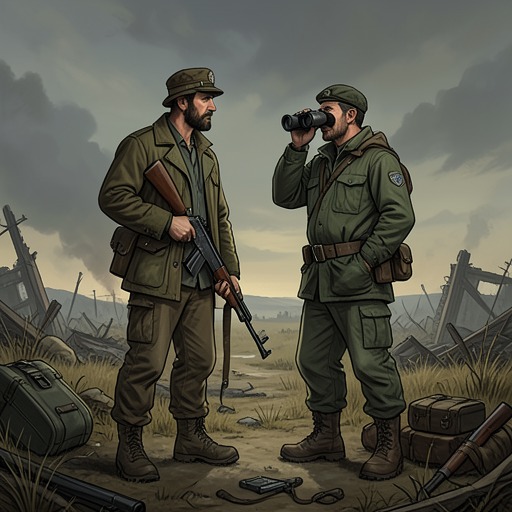
Hig–Bangley survival partnership
The Dog StarsThe Hig–Bangley survival partnership is the arrangement that makes life at an isolated country airport defensible: Hig supplies flight, observation, and a willingness to help, while Bangley supplies armed protection and a readiness to use force. The two men depend on one another, yet they do not share a moral code. Their alliance therefore offers more than a division of useful skills; it is a continuing argument over whether security comes from excluding danger or allowing an unknown person time to show who they are.
Formation and Material Basis
Hig describes having one neighbor: Bangley, whose full name he discovers as Bruce Bangley on the registration for an old, nonrunning truck. Their airport community is small, and the distance to the first juniper woods is eight miles of open prairie. That exposure gives their cooperation a practical urgency. Hig can cross the open ground, but a journey back with a deer would be difficult; Bangley watches over him from a position partway out. The partnership is established less through formal agreement than through shared necessity. Hig says the bargain was struck without negotiation, as if the division of their abilities had made the terms self-evident.
Their base has resources that are unusually valuable after the collapse: water, power, food, and firepower, with mountains close enough to reach if game becomes scarce. The airport’s houses have solar panels, and the fixed-base operation relies largely on wind power. Hig and Bangley retain handheld radios that recharge from the panels, allowing their work to remain coordinated beyond the immediate airport grounds. The arrangement is not simply a bond between two personalities; it is sustained by an interlocking set of machines, energy sources, routes, and skills.
Complementary Roles and Shared Defense
Hig characterizes the division bluntly: he has the plane and serves as the eyes; Bangley has the guns and is the muscle. Hig flies patrols because aerial observation is, in his assessment, the only way they can secure the perimeter. Bangley, meanwhile, covers him when he travels on foot. The roles are distinct but not interchangeable. Bangley cannot fly, while Hig does not have the stomach for killing. Each man’s limitation makes the other’s contribution essential, and the partnership gives the airport a defense neither could provide alone.
Bangley’s position is backed by formidable equipment and demonstrated skill. He sets a .408 CheyTac sniper rifle on a platform he built and uses a rangefinder; he says he can hit a person from a mile away, and Hig has seen him do so more than once. The radio link, solar charging, aircraft patrols, and long-range weapon together make vigilance a coordinated practice rather than a single guard’s task. Hig’s account also makes clear that this protection has a cost: Bangley once shoots a young girl who is chasing Hig across the open plain. Hig goes back after hearing the shot, but the encounter leaves visible the human consequence of a defense system built around preventing threats from reaching the perimeter.
Divergent Rules for Strangers
The deepest division between the men concerns how to judge a visitor. Bangley’s rule is to treat a stranger as guilty and shoot before asking questions; his warning is that negotiation amounts to negotiating one’s own death. Hig’s alternative is to let a visitor live a little longer, giving them a chance to demonstrate that they are human and not a threat. The disagreement is not an abstract difference in temperament. It determines who may approach, what counts as danger, and whether protection can include restraint.
Hig knows that Bangley’s harshness has helped keep him alive. He thinks of Bangley as the only neighbor and acknowledges that the man has saved him many times. That dependence makes dissent difficult: criticizing Bangley’s methods does not erase the protection those methods have provided. At one point Bangley is angry with Hig, and Hig recognizes the force of the accusation that softness could get him killed. Still, he questions whether survival achieved by living entirely according to Bangley’s way is worth its price. He understands himself as an apprentice to Bangley’s discipline, but not as a fully convinced adherent.
Uneasy Trust and Practical Care
The relationship is held together by more than weapons and obligation. Hig can ask Bangley directly what he wants him to do, even in a moment of distress. Bangley, in turn, apologizes to Hig and tells him to pull himself together. After Hig has been concussed, Bangley acknowledges the injury, expresses regret, and points out that it is better than being dead. He also praises Hig for doing well, emphasizing that Hig had expected to manage only two opponents but had taken four at the start. His approval is emphatic, a rare form of encouragement within a relationship usually described through work, risk, and defense.
The partnership also has friction in ordinary shared space. Jasper, Hig’s dog, generally cannot tolerate Bangley, though he keeps quiet during emergency visits. On one occasion Jasper snaps at Bangley, who draws a sidearm; Hig intervenes with a warning that shooting the dog would mean that all of them would die. The moment shows how quickly Bangley’s readiness for violence can threaten an attachment important to Hig, and how Hig can set a limit even while relying on Bangley’s protection. Their arrangement depends on boundaries as well as mutual service.
Adaptation and the Partnership’s Limits
Their work changes as survival becomes more than defense. Hig teaches Bangley how to water a garden, directing water from the header into the rows and showing him how to clear furrows and distinguish weeds from useful plants. Bangley is ornery about the instruction and admits that he had sworn never to be a farmer; the only dirt he expected to dig was grave dirt. The shift does not erase his guarded nature, but it places him in a shared task that requires learning, maintenance, and patience rather than marksmanship. The same alliance that organizes patrols can also accommodate practical cooperation in growing food.
Their material security remains vulnerable to forces neither man can command. Hig is frightened by two winters in which the mountain peaks held almost no snow, and he regards the loss of trout as serious and the possible loss of the creek as more consequential still. Later he sees the stream falling early and fast, its bed increasingly exposed, with fish and other creek life at risk. These observations sharpen the stakes of their reliance on water and food: a defended perimeter cannot preserve the resources on which it depends if the surrounding environment fails. The partnership can organize vigilance and labor, but it cannot make drought negotiable.
Significance
Hig and Bangley’s alliance presents survival as both a technical arrangement and an ethical conflict. Solar panels, wind power, radios, an aircraft, and a long-range rifle make their isolated home workable; the two men’s contrasting capacities make those tools effective. Yet their system does not settle the question of what kind of conduct security justifies. Bangley’s certainty reduces danger by refusing negotiation, while Hig’s impulse to delay judgment keeps open the possibility of recognizing a person rather than only a threat.
Neither position is cost-free in the world they inhabit. Hig cannot dismiss the fact that Bangley’s protection has repeatedly saved him, and Bangley cannot supply what Hig contributes from the air. Their partnership endures through dependence without resolving their disagreement. Its central tension is therefore built into its strength: the men can defend a shared perimeter together, but they do not agree on who should be allowed across it, or on what survival should ask of the people who remain inside.